
Revolutionary Texturing Process Yields Unprecedented Performance
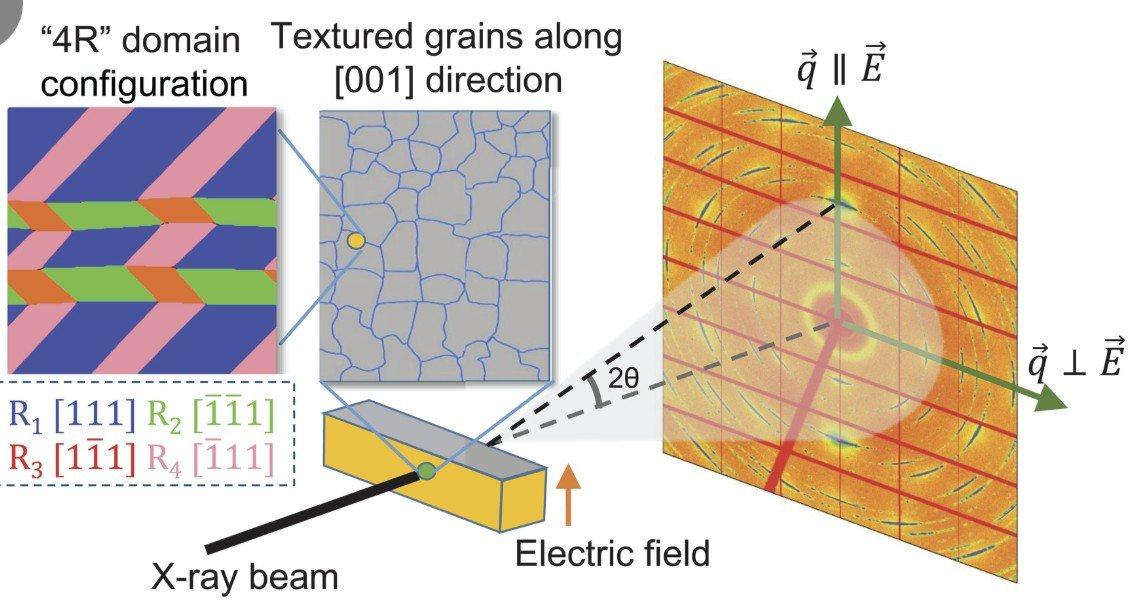
A landmark study published in Science has demonstrated that polycrystalline lead zirconate titanate (PZT) ceramics can achieve piezoelectric performance comparable to single crystals through a novel seed-passivated texturing process. This breakthrough, achieved by researchers from Xi'an Jiaotong University and international collaborators, relied critically on real-time structural characterization using Critus Pty Ltd's Transmission Geometry Cell at the European Synchrotron Radiation Facility (ESRF) to understand the mechanisms of material response.
The Research Achievement
The research team, led by Professor Fei Li, successfully developed textured PZT ceramics with extraordinary properties:
- Piezoelectric coefficient d₃₃ of 760 pC/N
- Electromechanical coupling factor k₃₃ of 0.85
- Voltage coefficient g₃₃ of 100 mVm/N
- Curie temperature of 360°C
These values represent a 60-100% improvement over conventional PZT ceramics while maintaining high temperature stability. The textured ceramics achieved >99% crystallographic alignment along the ⟨001⟩ direction, resulting in strain levels exceeding 0.57% at 50 kV/cm electric field.
Critical Role of Critus Transmission Geometry Cell
The Critus Transmission Geometry Cell provided essential capabilities that made these challenging experiments possible:
High-Energy X-ray Transmission Measurements
The Critus system's transmission geometry design was ideally suited for the high-energy X-rays at ESRF's ID15A beamline, enabling:
- Real-time monitoring of lattice strain evolution under electric fields up to 50 kV/cm
- Simultaneous texture and strain information at multiple crystallographic orientations
- Precise measurement of polarization rotation mechanisms
- Detection of domain switching behavior in textured grains
Synchronized Electromechanical Characterization
The integrated electrical measurement capabilities allowed researchers to:
- Apply controlled electric fields up to ±7.5 kV while collecting diffraction data
- Measure strain-electric field hysteresis loops in-situ
- Correlate structural changes with macroscopic electromechanical response
- Verify the polarization rotation mechanism driving enhanced performance
Temperature-Dependent Studies
The system's temperature capability (room temperature to 200°C) enabled:
- Characterization of material strain mechanisms across a broad temperature range
- Validation of consistent material performance from room-temperature to 200°C
- Confirmation of stable rhombohedral phase structure
Technical Insights from In-Situ Measurements
The Critus instrumentation revealed crucial mechanistic insights:
-
Polarization Rotation Mechanism: Real-time diffraction showed that enhanced strain arises from polarization rotation from ⟨111⟩ rhombohedral directions toward the [001] field direction, rather than domain switching.
-
Minimal Domain Switching: The (111) diffraction peaks remained stable under electric field, confirming that grain orientation prevented conventional 71° domain switching.
-
Reversible Lattice Strain: The system captured 0.47% reversible lattice strain with minimal remnant strain, demonstrating the elastic nature of the polarization rotation process.
-
Texture Quality Validation: Multi-angle diffraction measurements confirmed >94% grain alignment and quantified the 6% misaligned grain fraction.
Advantages of the Critus Transmission Geometry Design
The Critus Transmission Geometry Cell offered several key advantages for this study:
- High-Field Capability: Applied voltages up to ±7.5 kV enabled full characterization of the polarization rotation process
- Large Angular Range: Wide scattering angle access allowed comprehensive reciprocal space mapping
- Silicon Oil Bath: Prevented electrical breakdown at high fields while maintaining X-ray transparency
- Compact Design: Integrated seamlessly with synchrotron beamlines for efficient data collection
- Safety Interlocks: Ensured safe operation with high voltages in the experimental environment
Impact on Piezoelectric Technology
This research demonstrates how advanced in-situ characterization tools enable breakthrough discoveries in materials science. The ability to achieve single-crystal-like performance in polycrystalline ceramics while maintaining high Curie temperatures promises to revolutionize:
- Medical ultrasound transducers requiring high sensitivity and thermal stability
- Precision actuators for semiconductor manufacturing
- High-temperature sensors for automotive and aerospace applications
- Energy harvesting devices with enhanced efficiency
- Next-generation SONAR systems
Future Directions
The success of this work opens new avenues for materials development. The Critus Transmission Geometry Cell's ability to provide real-time structural insights under extreme electrical conditions will be crucial for:
- Optimizing texturing processes for other piezoelectric systems
- Developing lead-free alternatives with comparable performance
- Understanding domain engineering in complex ferroelectric compositions
- Advancing multi-functional materials with coupled properties
Conclusion
The groundbreaking results achieved in developing textured PZT ceramics underscore the critical importance of advanced in-situ characterization in modern materials research. Critus Pty Ltd's Transmission Geometry Cell, with its unique combination of high-field capability, temperature control, and compatibility with high-energy X-ray scattering geometries, proved instrumental in unlocking the mechanisms behind this revolutionary advance in piezoelectric materials.
As the field moves toward even more complex material systems and extreme operating conditions, the demand for sophisticated characterization tools will continue to grow. Critus remains at the forefront of enabling these discoveries through innovative instrumentation design.